Stay up to date with the latest news and information about sustainability legislation in the City of Irvine. Click on the titles below to learn more. The California State laws are noted with either SB or AB which is shorthand for Senate Bill or Assembly Bill.
For any inquiries regarding a Notice of Violation (NOV), please direct your correspondence to solidwaste@cityofirvine.org (Open in new window).
City Sustainability News, Updates, & Other Legislation
In January 2024, the State of California banned the sale of new small off-road engine-powered garden equipment (SORE) (Open in new window), such as leaf blowers, lawn mowers, string trimmers, hedge trimmers, and small chainsaws.
In December 2023, Irvine City Council passed Ordinance No 23-25 (Open in new window), which enacted a phased-out approach to the use of SORE gas equipment beginning July 1, 2024. As of January 1, 2025:
- Gas-powered leaf blowers are banned for use in Irvine by residents and small businesses.
- Gas-powered landscaping equipment, including leaf blowers, lawn mowers, hedge trimmers, string trimmers, and chainsaws, are banned for use in Irvine by large businesses.
- In January 2026, gas-powered landscaping equipment will be banned for residents and small businesses.
Ride along lawn mowers are exempt from this ordinance until the market catches up and there are quality electric ride along lawn mowers available.
For more details, visit cityofirvine.gov/lawnequipmentban (Open in new window).
Solid Waste Legislation & Policies
On January 27, 2026, the Orange County Board of Supervisors approved the Waste Infrastructure System Enterprise (WISE) Agreement, which replaces the Waste Disposal Agreement (WDA) effective July 1, 2026.
The WISE Agreement ensures participating cities, including Irvine, continue to receive priority access to Orange County landfills and competitive disposal rates. It also establishes a new 10-year agreement through June 30, 2036.
Orange County Waste & Recycling did not involve any of the 34 Orange County cities or special districts in planning and rolling out these costly programs. However, while this is a real cost increase, the City has limited alternatives given the County’s control of regional landfill infrastructure. Rejecting the agreement would actually cost the City even more. Learn more about Orange County’s landfills (Open in new window).
For more details, visit the Waste Infrastructure System Enterprise (WISE) Agreement.
Senate Bill (SB) 54, signed into law on June 30, 2022, established California's Extended Producer Responsibility (EPR) program for single-use packaging and plastic food service ware. The program became effective on May 1, 2026, following the adoption of regulations by CalRecycle. SB 54 shifts responsibility for managing packaging waste from local governments and taxpayers to the producers that manufacture and sell these materials.
SB 54 establishes statewide targets to reduce single-use plastic packaging by 25%, achieve a 65% recycling rate for covered materials, and require all covered packaging and plastic food service ware to be recyclable or compostable by 2032. Producers are also responsible for funding the collection, recycling, and disposal of covered materials through an approved Producer Responsibility Organization (PRO).
The law also requires producers to fund recycling infrastructure and plastic pollution mitigation efforts throughout California. Implementation is overseen by CalRecycle through a PRO, which is currently the Circular Action Alliance (CAA).
For more details, visit: CalRecycle's website (Open in new window).
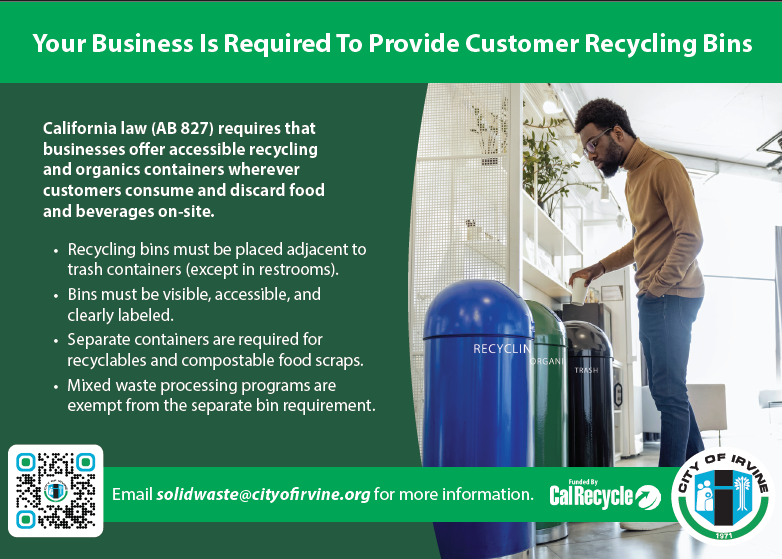
Effective July 2020, California Assembly Bill 827 (AB 827) requires businesses to provide customers with easily accessible recycling and organics collections bins or container.
Who is Required to Comply:
All commercial food service establishments that provide food for purchase and immediate consumption on site must comply. A business, defined as a commercial or public entity (such as a school or hospital) including multifamily residential dwelling (5 units or more), that generates 2 or more cubic yards of commercial solid waste per week.
Key Requirements:
- Businesses must provide customers with organic/compost and recycling bins.
- Bins are adjacent to in-house trash bins (bathrooms excluded).
- Bins must be clearly visible and easily accessible.
- Bins must be properly labelled to indicate what materials can be placed within.
To meet requirements, businesses must do the following:
- Commercial food establishments provide customers with bins to collect organic/compost and recycling materials adjacent to each in-house trash bin.
- All three bins (trash, recycling, organics) are visible and accessible with clearly marked signage educating on what can be placed in the bins.
- All bins are properly serviced by waste management provider. (Recycling is actually being serviced)
Exemptions: Full-service restaurants may be exempt if they comply with employee sorting programs, like providing properly labelled organics and recycling bins in the back of house.
For more details, visit: California Legislative Information website (Open in new window).
Printable Flyers (Open in new window) for Tenants.
Printable Flyers (Open in new window) for Businesses.
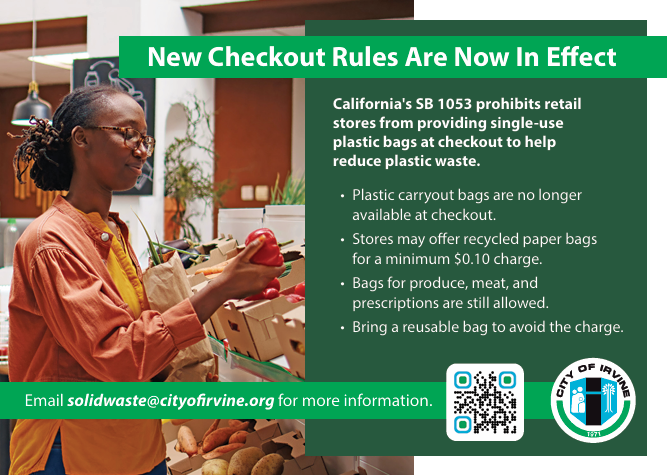
California Senate Bill 1053 (SB 1053) aims to reduce the distribution of plastic pollution by eliminating single-use plastic bags at retail stores. Effective January 1, 2026, single-use plastic carryout bags are banned from use at most retail checkouts.
Who is Required to Comply:
SB 1053 applies to retail stores that provide carryout bags to customers at the point-of-sale including grocery stores, retail stores with pharmacies, convenience stores, food marts, and liquor stores. A “store” under this law is any business location where goods are sold and a carryout bag might be provided during checkout or order fulfillment.
Key Requirements:
- Beginning January 1, 2026, stores may not provide, distribute, or sell plastic carryout bags at the point of sale.
- Stores may only provide recycled paper carryout bags for a minimum charge of $0.10 per bag. The fee is retained by the store and is intended to offset the cost of providing compliant bags.
- Starting January 1, 2028, recycled paper bags provided by stores must contain at least 50% postconsumer recycled materials.
To meet requirements, stores must do the following:
- Cease distribution of prohibited plastic carryout bags at checkout.
- Provide only qualified recycled paper bags that meet the minimum recycled content requirement.
- Charge the minimum fee ($0.10) for recycled paper bags provided.
- Train staff on which bags are allowed and how to comply at self-checkout and delivery stations, inform customers of changes.
For more details, visit: California Legislative Information website (Open in new window).
Printable Flyers (Open in new window) for Businesses.
Printable Flyers (Open in new window) for Property Managers.
Printable Flyers (Open in new window) for Residents.
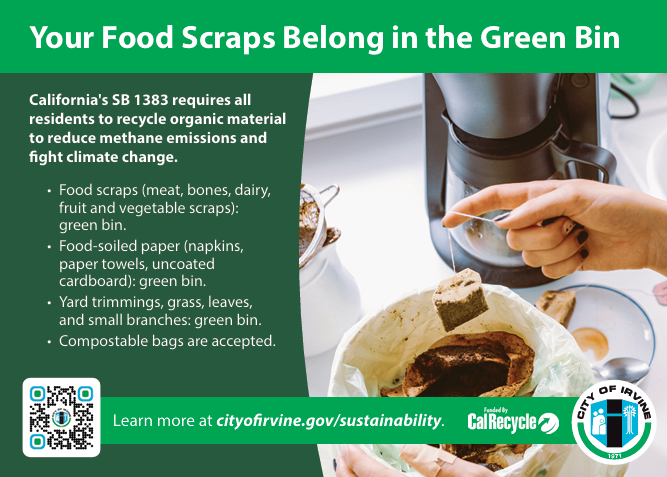
California Senate Bill 1383 (SB 1383), part of the state’s Short-Lived Climate Pollutant Reduction strategy, establishes mandatory organic waste recycling and edible food recovery requirements to reduce methane emissions from landfills. It sets statewide targets to reduce organic waste disposal by 75% and recover at least 20% of currently disposed edible food by 2025.
Who is Required to Comply:
A “organics waste generator” applies to any person or entity that produces organics waste, including food scraps, yard waste, food soiled paper, and other compostable materials.
SB 1383 applies to:
- All California residents (single-family homes).
- Multi-family residential complexes (5 units or more).
- Businesses and commercial generators (see Tier 1 & Tier 2 Generator descriptions).
- Schools, public entities, and other organizations that generate organic waste.
Tier 1 Commercial Edible Food Generator:
Tier 1 businesses typically have more produce, fresh grocery, and shelf-stable foods to donate. This may include:
- Wholesale food vendors
- Food service providers
- Food distributors
- Grocery stores and supermarkets (≥ 10,000 sq. ft.).
Tier 2 Commercial Edible Food Generator:
Tier 2 businesses have prepared foods to donate, often requiring careful handing for food safety requirements. This may include:
- Restaurant facilities (≥ 5,000 sq. ft. Or 250+ seats)
- Hotels with on-site food facility and 200+ rooms
- Health facilities
- State agency cafeterias (≥ 5,000 sq. Ft. Or 250+ seats)
- Large venues and events
- Local education agencies with on-site food facilities.
Key Requirements:
- Organics separation and collection
- Color-coded and labeled containers
- Edible food recovery program – required for tier 1 and tier 2 commercial edible food generators
- Contamination monitoring
For more details, visit: cityofirvine.gov/sb1383 (Open in new window).
Printable Flyer (Open in new window) for Residents.
Printable Flyer (Open in new window) for Businesses.
Printable Flyer (Open in new window) for Tenants.
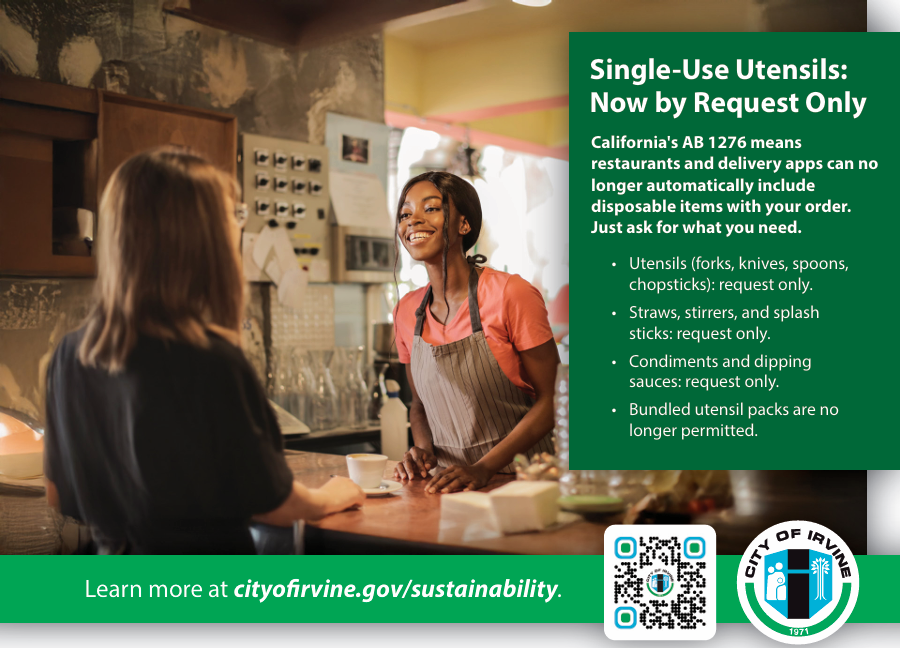
Assembly Bill (AB) 1276, signed into law on October 5, 2021, prohibits California food facilities from automatically providing single‑use foodware accessories or standard condiment items unless the consumer specifically requests them. These items, such as utensils, straws, condiment cups and packets, lids, stirrers, toothpicks, ketchup, mustard, salt, sugar, soy sauce, hot sauce, etc., must be individually requested and cannot be pre-bundled or packaged together.
For more details, visit cityofirvine.gov/ab1276 (Open in new window).
Printable Flyers (Open in new window) for the General Public.
Printable Flyers (Open in new window) for Property Managers.
Printable Flyers (Open in new window) for Food Service Businesses.
Energy Legislation & Policies
Rule 1146.2 - Emissions of Oxides of Nitrogen from Large Water Heaters and Small Boilers and Process Heaters
In June 2024, The South Coast Air Quality Management District amended Rule 1146.2 to require new and existing buildings in Southern California to transition to zero-emission water heaters, boilers, and process heaters. The purpose of Rule 1146.2 is to reduce the emission of nitrous oxides and carbon monoxide from a variety of appliances that are powered with natural gas. These appliances will be phased out starting January 1, 2026, through January 1, 2033.
Rule 1146.2 is applicable to manufacturers, distributers, sellers and resellers, installers, and owners of these products. The detailed requirements can be seen here (Open in new window), and a list of certified products that meet the ruling requirements can be seen on the South Coast Air Quality Management District website (Open in new window).